Asbestos Removal Richmond: Protecting Lower Mainland Families

Richmond sits in a unique position in Metro Vancouver. It is one of the most rapidly developing cities in BC, with new towers going up near Brighouse and Lansdowne, new mixed-use neighbourhoods replacing old industrial land, and a housing market that moves fast.
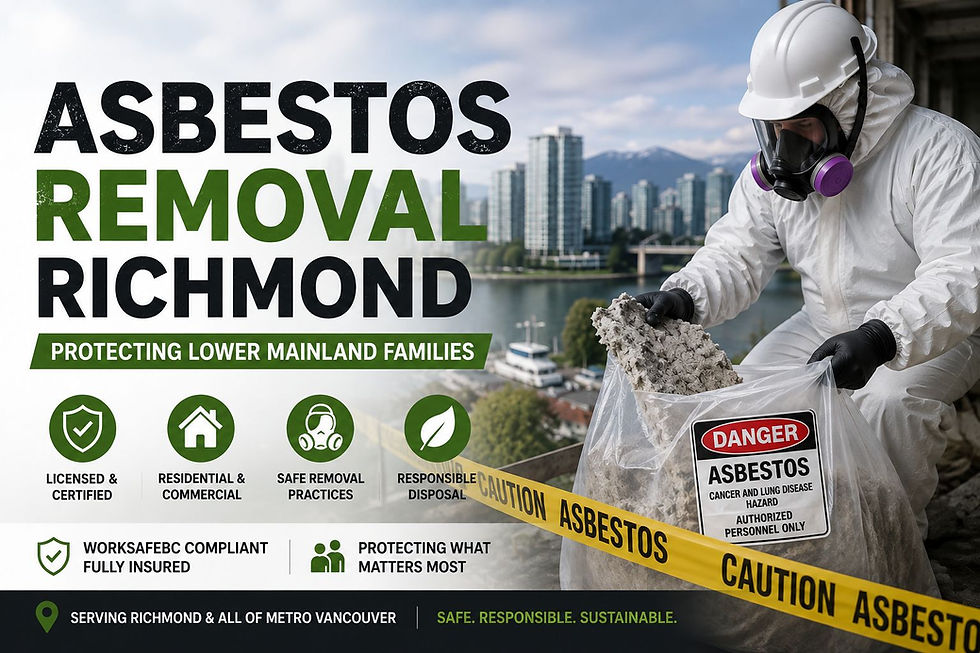
But underneath that modern growth, Richmond has something many homeowners do not think about until they are deep into a renovation project: a substantial amount of older housing stock built during the decades when asbestos was a standard construction material. This makes Asbestos Removal Richmond an important consideration for homeowners planning renovations, repairs, or demolition work.
If your Richmond home was built before 1990 and you are planning any kind of renovation or demolition, this guide is for you. BC Green Demolition provides professional asbestos testing and removal for Richmond homeowners, landlords, and strata buildings. Here is what you actually need to know.
Richmond's Housing History and Why Asbestos Matters Here
Richmond developed rapidly between the 1950s and the 1980s. Established neighbourhoods like Steveston, Garden City, Hamilton, Broadmoor, and the areas around No. 3 Road were largely built out during this period. That is exactly the window when asbestos was mixed into building materials across Canada as a matter of routine.
Asbestos was valued at the time for being cheap, fire-resistant, and durable. It made its way into ceiling texture, floor tiles, pipe insulation, drywall joint compound, roofing materials, and exterior cladding. Nobody thought to question it. Regulations did not catch up until the health risks were already well understood by researchers, and by then the materials were inside millions of Canadian homes.
Richmond also has a notably high proportion of strata buildings from the 1970s and 1980s. Low-rise wood-frame strata complexes are one of the most common property types in areas like West Richmond and Seafair, and they frequently contain asbestos in shared mechanical systems, common area ceilings, and individual unit finishes from the original build.
BC Green Demolition works regularly with Richmond homeowners and strata councils dealing with exactly these situations.
The Part Most People Get Wrong About Asbestos
Here is what catches Richmond homeowners off guard more than anything else.
Asbestos does not look like anything. It has no colour, no smell, no visible texture that distinguishes it from non-asbestos materials. A stipple ceiling with asbestos looks identical to one without. A vinyl tile containing asbestos looks the same as a safe one. Pipe insulation with asbestos wrapping is visually indistinguishable from the non-asbestos variety.
This means that checking visually whether a material is safe is simply not possible. It also means that well-intentioned homeowners who try to sand, scrape, or remove materials in older Richmond homes without testing first are taking a genuine risk without knowing it.
The only reliable answer is laboratory testing. BC Green Demolition collects samples of suspected materials, sends them to an accredited lab, and gives you a formal written report with confirmed results. That report is also a regulatory requirement under WorkSafeBC rules before any renovation or demolition work begins in a pre-1990 building.
Where BC Green Demolition Commonly Finds Asbestos in Richmond Homes
Every Richmond property is different, but based on the surveys our team conducts across the city, here are the locations that come up most frequently:
Stipple and popcorn ceilings. This is the single most common finding in Richmond homes built between the early 1960s and approximately 1985. The spray-applied ceiling texture that was fashionable throughout that era regularly contained asbestos. It looks completely normal and stable until someone tries to skim-coat, sand, or remove it.
Vinyl floor tiles and black adhesive. The older square vinyl tiles, often nine by nine inches, were widely used in Richmond homes and frequently contain asbestos. Just as importantly, the black mastic adhesive used to install them is often asbestos-containing as well. These are commonly discovered under newer flooring when Richmond homeowners renovate kitchens or bathrooms.
Vermiculite attic insulation. If your Richmond home has a granular grey insulation material in the attic that looks a bit like small grey pebbles, it should be tested. A large proportion of vermiculite sold in Canada came from a mine with known asbestos contamination. BC Green Demolition treats all vermiculite insulation as presumed asbestos-containing until testing confirms otherwise.
Pipe and duct insulation in basements. Mechanical rooms in older Richmond homes frequently have asbestos-wrapped pipes and furnace ducts. When this insulation deteriorates and becomes friable, meaning it crumbles easily, it releases fibres without being actively disturbed.
Drywall joint compound. This surprises most people. The compound used to finish drywall seams in homes built through the 1970s frequently contained asbestos. Sanding drywall surfaces in a pre-1990 Richmond home is a high-risk activity without prior testing.
Strata common areas. In Richmond strata buildings from the 1970s and 1980s, asbestos is often present in boiler rooms, common area ceilings, shared mechanical chases, and original common-area flooring. Strata renovation projects require careful hazardous materials assessment before work begins.
What Is Actually Unique About Richmond: Flood Plain and Crawl Space Moisture
One thing that genuinely distinguishes Richmond from other Metro Vancouver cities is its geography. Richmond sits on a low-lying river delta, and while the flood protection infrastructure is well maintained, the implications for older homes are real.
Many older Richmond homes built on the lower parts of the delta have crawl spaces that are more susceptible to ground moisture than homes in elevated areas. Chronic moisture in crawl spaces promotes the deterioration of any insulation present, including asbestos-containing pipe and subfloor insulation. When that insulation breaks down, it becomes friable and starts releasing fibres into the crawl space environment.
BC Green Demolition regularly encounters this specific situation in older Richmond properties, particularly those in the Hamilton and Steveston areas. If you have a pre-1990 Richmond home with a crawl space and you have not had it professionally assessed, it is worth adding to your list.
Fresh in 2026: What Richmond Homeowners Should Know About the Licensing Change
Since January 2024, British Columbia has required all asbestos abatement contractors to hold a formal WorkSafeBC Asbestos Abatement Licence. BC was the first province in Canada to implement this level of regulatory oversight for asbestos work.
For Richmond homeowners, this is genuinely useful information because it gives you a way to verify any contractor before you hire them. The WorkSafeBC AAL Registry is publicly searchable at worksafebc.com. You can look up any contractor by name and confirm whether they hold a valid licence.
BC Green Demolition is a licensed asbestos abatement employer under this system and will provide our licence number to any Richmond client who asks. If a contractor you are considering cannot give you a licence number that checks out in the registry, that is a serious red flag.
How BC Green Demolition Handles Asbestos Removal in Richmond
The process is consistent across every Richmond project we take on, regardless of size.
It starts with a free consultation and site visit. BC Green Demolition comes to your Richmond property, inspects all areas of concern, and collects bulk samples from suspected materials for accredited laboratory analysis. You receive a formal Hazardous Materials Survey report with clear findings and recommendations.
If asbestos is confirmed in materials that will be disturbed by your renovation or demolition plans, BC Green Demolition prepares a detailed removal work plan and files the required Notice of Project with WorkSafeBC before any work begins.
On site, our certified workers seal the affected area using heavy polyethylene sheeting and run HEPA-filtered air machines to maintain negative air pressure inside the containment zone. This prevents fibres from travelling to other parts of your Richmond home while removal is underway.
Asbestos-containing materials are carefully removed, double-bagged in labelled containers, sealed on site, and transported by a licensed carrier to an approved disposal facility. After removal, independent air clearance testing confirms the space is safe before you or your renovation contractor re-enters.
You receive a complete project file at the end: survey report, work plan, Notice of Project confirmation, air clearance certificate, and waste disposal documentation. This covers you for renovation permits, real estate disclosure, strata records, and insurance purposes.
FAQ: Asbestos Removal in Richmond BC
Is there an asbestos removal company in Richmond BC?
Yes. BC Green Demolition is a WorkSafeBC-licensed asbestos abatement contractor serving Richmond and all of Metro Vancouver. We provide asbestos surveys, professional removal, and complete documentation for Richmond homeowners, strata corporations, landlords, and contractors.
How do I get asbestos tested in Richmond?
Contact BC Green Demolition for a free on-site inspection. Our team visits your Richmond property, identifies materials likely to contain asbestos, and collects samples for accredited laboratory analysis. You receive a formal written survey report confirming what is present and what the recommended course of action is.
Do I need an asbestos survey before renovating my Richmond home?
Yes, and it is a legal requirement under WorkSafeBC regulations. Before any renovation or demolition work in a building that may contain asbestos-containing materials, a formal hazardous materials survey must be completed by a qualified person. This applies to virtually all Richmond homes built before 1990. BC Green Demolition conducts compliant pre-renovation surveys across all Richmond neighbourhoods.
My Richmond strata is planning renovations. Does it need an asbestos assessment first?
Yes. Strata buildings in Richmond from the 1970s and 1980s frequently contain asbestos in common areas, shared mechanical systems, and original unit finishes. BC Green Demolition works with Richmond strata councils and property management companies to conduct building-wide asbestos surveys, manage removal, and provide the documentation strata corporations need before approving renovation work.
Can the asbestos in my Richmond home make my family sick even if we are not renovating?
Asbestos-containing materials that are in good condition and left completely undisturbed present a lower immediate risk. The danger increases when those materials start to deteriorate or when any renovation disturbs them. If you have young children in a pre-1990 Richmond home, a proactive survey from BC Green Demolition gives you confirmed information rather than uncertainty.
What should I do if I find what looks like asbestos during a Richmond renovation?
Stop all work immediately and keep everyone out of the affected area. Do not attempt to clean, cover, or remove the material yourself. Contact BC Green Demolition for an urgent assessment. Continuing renovation after discovering suspected asbestos is a WorkSafeBC violation and creates a genuine health risk for anyone in the building.
How do I verify that a Richmond asbestos contractor is properly licensed?
Ask for their WorkSafeBC Asbestos Abatement Licence number and verify it at worksafebc using the publicly searchable AAL Registry. BC Green Demolition is a licensed asbestos abatement employer and provides our licence details to all Richmond clients on request.
How long does asbestos removal take in a Richmond property?
A focused single-area project, like a stipple ceiling removal or floor tile abatement, typically takes one to two days including containment setup and post-removal clearance testing. Larger pre-renovation or pre-demolition projects may take three to seven days depending on the scope. BC Green Demolition provides a clear timeline during the free initial consultation.
Does BC Green Demolition handle asbestos in Richmond strata buildings as well as single-family homes?
Yes. BC Green Demolition serves both single-family homeowners and strata buildings in Richmond. For strata projects, we work with property managers and strata councils to coordinate surveys, manage scheduling around occupants, and provide the formal documentation required for strata records and insurance purposes.
Get Your Free Richmond Asbestos Assessment
Whether you are planning a kitchen renovation in Steveston, preparing a Garden City home for sale, managing a strata building near Brighouse, or dealing with an older property in Hamilton, BC Green Demolition provides professional asbestos testing and removal across all of Richmond.
Free consultation. Formal written quote. Fully documented from survey through to clearance certificate.


Comments